Which EU obligations must a Shopify shop meet?
The obligations are yours as the seller. Shopify provides the platform. The country you sell into is decisive. For shops that sell to consumers, four topics often come together. As of 18 November 2026, checked against the legal texts and the Shopify help pages of the same day.
One special case is Shopify Managed Markets. The Help Center says: “When you use Managed Markets, Global-e becomes the merchant of record.” For these orders, the partner Global-e therefore acts as the seller towards the customer. Without Managed Markets, you sell yourself.
| Topic | Legal basis | Applies under EU law from |
|---|---|---|
| Notice on the legal guarantee, GARAN label | Art. 22a Directive 2011/83/EU (inserted by Directive (EU) 2024/825), Implementing Regulation (EU) 2025/1960 | 27 September 2026 (directive: national transposition; Implementing Regulation: directly) |
| Withdrawal function (withdrawal button) | Art. 11a Directive 2011/83/EU (inserted by Directive (EU) 2023/2673) | 19 June 2026 (national transposition) |
| Lowest price of the last 30 days (Omnibus price indication) | Art. 6a Directive 98/6/EC (inserted by Directive (EU) 2019/2161) | 28 May 2022 (national transposition) |
| Manufacturer information and responsible person in the offer | Art. 19 Regulation (EU) 2023/988 (GPSR, EU General Product Safety Regulation) | 13 December 2024 (directly) |
The first three rows rest on directives. For them, the law of the target country applies. The Implementing Regulation governs only the design and content of the notice and label and applies directly, as does the GPSR. How far the countries have got is shown in the overview of implementation status. Rules of individual countries are under Countries.
How do I show the legal guarantee notice in Shopify?
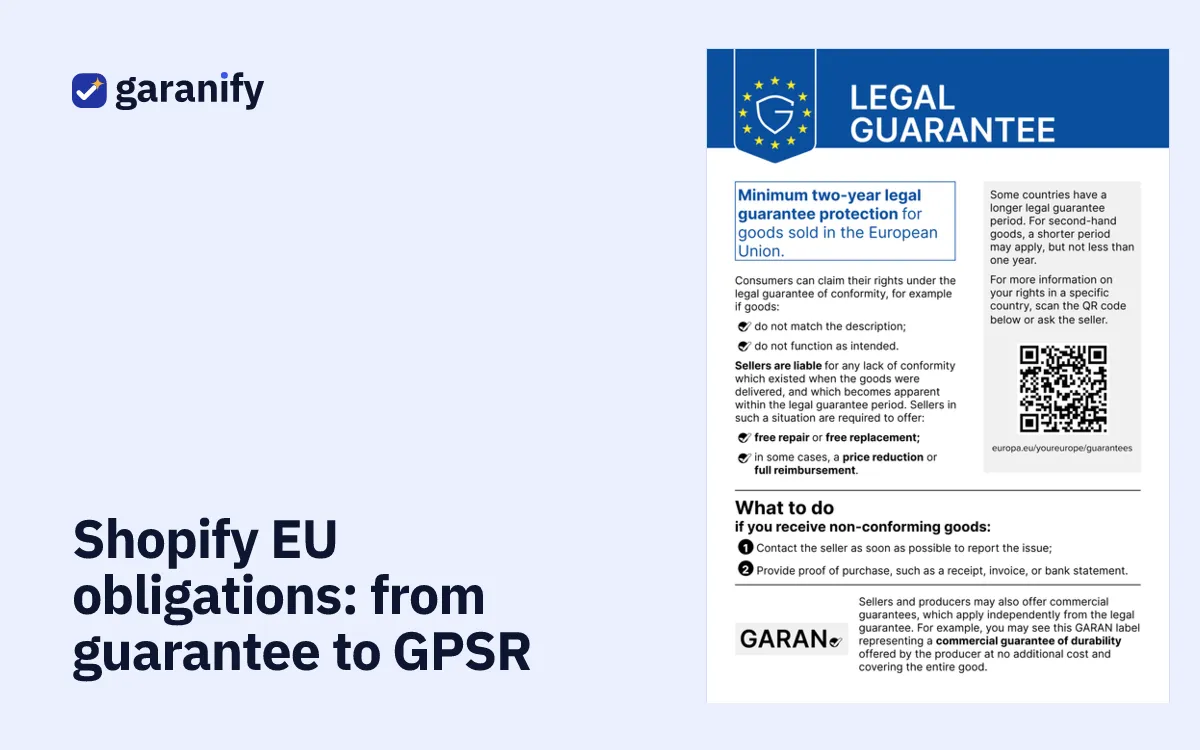
Under Article 22a(1) of Directive 2011/83/EU, the harmonised notice is to be used for the pre-contractual information on the legal guarantee (Art. 5(1)(e), Art. 6(1)(l)). Design and content are set by Annex I of Implementing Regulation (EU) 2025/1960. On an online interface, notice and label appear in colour (Annexes I and II, see recital 14). The GARAN label (Annex II) is added if the manufacturer gives a free commercial guarantee of durability of more than two years for the whole product and makes this information available to the trader (Art. 6(1)(la) Directive 2011/83/EU, see recital 8).
We found no Shopify help page on the notice on help.shopify.com. Shopify names no function of its own for it. You therefore need a theme adjustment or an app.
Garanify for Shopify is in preparation and not yet in the Shopify App Store. An app block for the product page and an app embed for the cart and drawer are planned. The GARAN label appears only with valid data: more than two years, brand and model. How the setup is meant to work is described in the guide Add the legal guarantee notice in Shopify.
Limit of the checkout: The developer documentation says: “Checkout UI extensions for the information, shipping, and payment steps are available only to stores on a Shopify Plus plan.” Your own content in these checkout steps is therefore only available with Shopify Plus. Garanify is planned only for the product page and cart, and a display in the checkout on no plan (see help on cart and drawer). The notice belongs before the conclusion of the contract. Whether the product page and cart suffice under the law of your target country is a legal question this article does not answer.
Withdrawal button in Shopify: what does Shopify offer?
Article 11a of Directive 2011/83/EU requires a withdrawal function for contracts concluded through an online interface. It is clearly legible, labelled “withdraw from contract here” or an equivalent unambiguous wording, and available throughout the withdrawal period. In Germany, this is in § 356a(1) BGB (German Civil Code). Through the function, the consumer submits an online withdrawal statement with name, contract details and the means of communication for the confirmation. A confirmation function (“confirm withdrawal”) follows, and then without delay an acknowledgement of receipt on a durable medium. The Directive requires application from 19 June 2026. In Germany, § 356a BGB has applied since that day. In Austria, § 13a FAGG (Distance and Off-Premises Contracts Act) applies to contracts concluded after 30 September 2026 (§ 20(5) FAGG). Details are in the article on the withdrawal button in the online shop.
The Shopify Help Center describes the obligation. For shops without Managed Markets, it names return and cancellation rules, including self-service returns and market-specific EU policies. For Managed Markets orders, Shopify says it automatically applies rules that are meant to meet the requirements. We have not checked this. Whether the settings cover all elements, such as the two-step confirmation, the page does not say. You must check that yourself.
There is no Garanify module for the withdrawal function today. It is in preparation.
Omnibus price in Shopify: using the compare-at price correctly
Article 6a(2) of Directive 98/6/EC defines the prior price as “the lowest price applied by the trader during a period of time not shorter than 30 days prior to the application of the price reduction” (wording of the English Official Journal version). Member States may deviate for some cases, for example for goods liable to deteriorate or expire rapidly (paragraph 3). Check the rule of your target country, therefore. Background is in the article Omnibus Directive: the price of the last 30 days.
According to the Help Center, you enter the lowest price you charged in the 30 days before the reduction in the “Compare-at price” field. If your country provides for a longer period, that period applies. You enter the new price in the “Price” field. The compare-at price must be higher than the price.
The admin has only two price fields. For reductions more often than every 30 days, Shopify therefore advises adjusting the theme so that the regular price and the lowest earlier price appear. Unclear: whether compare-at prices are shown or hidden by default for EEA customers if your main market is outside the EEA and you sell through Markets or Global-e. The help page says “displayed by default” in one place and “hidden by default” in another. Check the “Hide compare-at” setting per market under Markets in the further settings. The page does not describe an automatic price history.
There is no Garanify module for the Omnibus price indication today. It is in preparation.
Storing GPSR information in Shopify
Article 19 of Regulation (EU) 2023/988 requires the offer, in distance sales, to indicate certain information clearly and visibly. This includes the name and contact details of the manufacturer and, for a manufacturer outside the Union, of the responsible person. It also includes information identifying the product with an image, and warnings and safety information. What exactly belongs on the product page is explained in the article GPSR product page requirements.
For legally required product warnings, the Help Center points to the product metafield “Disclosures” and to metaobject entries. You can put further mandatory information in the product description or in a product metafield. On the role of the responsible person, Shopify writes that it does not currently offer such services directly.
There is no Garanify module for GPSR information today. It is in preparation.
What to do now
- Decide which countries you sell into and check the status of the four topics there.
- The notice on the legal guarantee belongs before the conclusion of the contract. Whether the product page and cart suffice for your target country is something to clarify with your legal adviser if in doubt. The duty check shows which display obligations may apply to your shop.
- In Shopify, open the pages on return and cancellation rules and on the compare-at price, and compare the settings with each obligation.
- Store the GPSR information per product in metafields or in the description.
- The status of the Garanify app for Shopify is on the page Garanify for Shopify, plans under Pricing.
Not legal advice. Garanify currently implements the display obligations of Implementing Regulation (EU) 2025/1960 technically; further modules are in preparation.