Withdrawal button: who must offer it, and since when?
As of 18 November 2026. Scope: EU directive and German law, with a short note on Austria. We have not checked other countries.
Every trader that concludes distance contracts with consumers through an online interface, that is a website or an app, needs the withdrawal button (§ 356a(1) sentence 1 BGB, recital 37 of Directive (EU) 2023/2673). Distance contracts are contracts concluded exclusively by means of distance communication, for example through an online shop. The German statute calls the button „Widerrufsfunktion“ (our translation: “withdrawal function”).
The obligation has two limits. It applies only towards consumers, so pure B2B shops are not affected. And it applies only where a right of withdrawal exists at all. That is governed by § 312g BGB. Its paragraph 2 excludes, for example, goods made to the customer’s individual specification, goods liable to deteriorate rapidly and sealed hygiene products whose seal has been broken.
The dates. Directive (EU) 2023/2673 inserted Art. 11a into the Consumer Rights Directive 2011/83/EU (Art. 1 point 3). Member States had to adopt their rules by 19 December 2025 and apply them from 19 June 2026 (Art. 2(1)). In Germany the Act of 3 February 2026 (BGBl. 2026 I Nr. 28, promulgated on 5 February 2026) restated § 356a BGB. Under Art. 10(1) it has applied since 19 June 2026. The same Act contains the rules on the legal guarantee notice, which entered into force on 27 September 2026 under Art. 10(3).
Austria. There § 13a FAGG governs the function under the name „Rücktrittsfunktion“ (our translation: “withdrawal function”). It is to be labelled „Vertrag widerrufen“ or an equivalent unambiguous wording, and the confirmation function „ausschließlich“ (our translation: “only”) with „Widerruf bestätigen“ or an equivalent unambiguous wording (§ 13a(2) and (4) FAGG). Under § 20(5) FAGG, § 13a as amended by BGBl. I Nr. 59/2026 applies from 1 October 2026 to contracts concluded after 30 September 2026. The model withdrawal notice in Annex 1 to the FAGG contains a building block for it. We have not checked further Austrian details.
How does withdrawal through the button work?
§ 356a BGB describes the process in five paragraphs:
| Step | What the law requires | Reference |
|---|---|---|
| 1. Button | Label „Vertrag widerrufen“ (our translation: “withdraw from contract”) or equivalent, easily legible. Continuously available throughout the withdrawal period, prominently displayed, easily accessible | § 356a(1) |
| 2. Details | The consumer can easily provide or confirm their name, details of the contract or part of the contract, and the electronic means for the confirmation | § 356a(2) |
| 3. Confirmation | A second button „Widerruf bestätigen“ (our translation: “confirm withdrawal”) or equivalent, easily legible | § 356a(3) |
| 4. Acknowledgement of receipt | Without undue delay on a durable medium, at least with the content of the statement and the date and time of receipt | § 356a(4) |
| 5. Preserving the deadline | The statement counts as received in time if the consumer sent it through the function before the period expired | § 356a(5) |
A durable medium is a medium on which the customer can store the message. The model withdrawal notice gives an email as an example.
The label in the exact wording. The German statute and the Directive word this slightly differently. Under § 356a(1) sentence 2 BGB the function is labelled „Vertrag widerrufen“ or „einer anderen gleichbedeutenden eindeutigen Formulierung“ (our translation: “another equivalent unambiguous formulation”). Art. 11a(1) of the Directive speaks of “withdraw from contract here” or “an unambiguous corresponding formulation”. For the confirmation, Art. 11a(3) requires that it is “labelled in an easily legible manner, and only with the words “confirm withdrawal” or with an unambiguous corresponding formulation”. § 356a(3) BGB does not adopt the word „ausschließlich“ (“only”).
Partial withdrawal. The function must make it possible to withdraw from only part of a contract. § 356a(2) no. 2 BGB requires details identifying „des Vertrags oder des Teils des Vertrags, den der Verbraucher widerrufen möchte“ (our translation: “the contract or the part of the contract that the consumer wishes to withdraw from”). Anyone who has ordered three items must therefore be able to withdraw from just one of them through the button. The Directive is more open here: recital 37 says the trader “can” provide the possibility to withdraw from a part rather than the whole of the contract. In Germany the stricter wording of the BGB applies.
Duration. The button must be available throughout the withdrawal period (§ 356a(1) sentence 3 BGB). The period is 14 days (§ 355(2) BGB). For goods it generally starts when the customer has received the goods (§ 356(2) no. 1 BGB).
What does recital 37 say about the design?
Recitals come before the operative text of a directive and explain what the legislator intends. They are an aid to interpretation and not an obligation of their own. Recital 37 says:
- Consumers should be able to withdraw from a contract just as easily as they conclude it.
- The consumer should not have to undertake procedures to find or access the function, such as downloading an application if the contract was not concluded via that application.
- The trader could provide hyperlinks leading the consumer to the function.
- A consumer who has already identified themselves, for example by logging in, should not have to provide their identification or the identification of the contract once more.
- The obligation applies to all distance contracts that are subject to the right of withdrawal under Directive 2011/83/EU. Financial services are only a part of them.
The button comes in addition to the existing routes. Under Art. 11a(1) the consumer can “also” withdraw from the contract by using the function. A letter, an email and the voluntary online form under § 356(1) BGB remain available.
What belongs in the withdrawal notice?
Where a right of withdrawal exists, the trader also informs the consumer „gegebenenfalls über das Bestehen und die Platzierung der Widerrufsfunktion nach § 356a“ (Art. 246a § 1(2) sentence 1 no. 1 EGBGB; our translation: “where applicable, of the existence and placement of the withdrawal function under § 356a”). The model withdrawal notice in Annex 1 to the EGBGB has a building block for this: „Sie können Ihr Widerrufsrecht auch online unter … ausüben.“ (our translation: “You can also exercise your right of withdrawal online at …”). It also announces that, after the function has been used, the trader sends an acknowledgement of receipt with content, date and time without undue delay.
If the information is missing, the period may stay open. § 356(3) sentence 1 BGB reads: „Die Widerrufsfrist beginnt nicht, bevor der Unternehmer den Verbraucher entsprechend den Anforderungen des Artikels 246a § 1 Absatz 2 Satz 1 Nummer 1 des Einführungsgesetzes zum Bürgerlichen Gesetzbuche unterrichtet hat.“ (our translation: “The withdrawal period does not begin before the trader has informed the consumer in accordance with the requirements of Article 246a § 1(2) sentence 1 no. 1 of the Introductory Act to the Civil Code.”) Since 19 June 2026 this very number contains the reference to the withdrawal function. Without a proper withdrawal notice the right of withdrawal lasts longer. It expires at the latest twelve months and 14 days after the regular start of the period (§ 356(4) sentence 1 BGB).
The case where the notice is complete and only the sentence on the withdrawal function is missing is disputed. By its wording, that too prevents the period from starting. We have found no court decisions on it. Have your withdrawal notice checked for the building block with your legal text provider.
What is the risk without a withdrawal button?
If the notice also lacks the reference to the button, the withdrawal period cannot start by the wording of the law (§ 356(3) BGB, see above). In addition there is a fine provision with narrow conditions. Art. 246e § 1(2) no. 14a EGBGB names a missing withdrawal function, one not designed in line with § 356a(1) to (3) BGB, and a missing acknowledgement of receipt under paragraph 4. Under § 1(1), however, such an infringement is prohibited only if it is widespread within the meaning of Art. 3 point 3 or point 4 of Regulation (EU) 2017/2394. That means infringements that affect consumers in several Member States. Under § 2(1), anyone who acts intentionally or negligently in doing so commits an administrative offence.
The range goes up to EUR 50,000 (§ 2(2)). For an annual turnover above EUR 1.25 million, up to 4 per cent of annual turnover in the Member States concerned is possible (§ 2(3)). A fine is imposed only within a coordinated enforcement action under Art. 21 of Regulation (EU) 2017/2394, that is a joint action by several national authorities (§ 2(5)). The competent authority is the Federal Office of Justice (Bundesamt für Justiz, § 2(6)). Whether competitors and associations can issue warning letters is not covered by this article.
Which questions are open?
- Footer link. The law requires „hervorgehoben platziert“ and „leicht zugänglich“ (our translation: “prominently displayed” and “easily accessible”). Recital 37 allows hyperlinks to the function. Whether a link in the footer alone is prominent enough is not settled by the rules.
- Login. Recital 37 describes logged-in customers. It does not say whether a shop may require a login.
- Further mandatory fields. § 356a(2) names three details that the customer must be able to give easily. Whether additional mandatory fields such as a return reason are allowed is not regulated.
- “Only”. How strictly the word from Art. 11a(3) is to be read where the confirmation button carries additional text is not settled.
- Mixed orders and older contracts. It is open how the function deals with orders that contain goods with and without a right of withdrawal. It is equally open whether it applies to contracts concluded before 19 June 2026. The Act of 3 February 2026 contains no transitional provision on this.
Outlook: Digital Fairness Act (proposal only)
On 11 November 2026 the Commission proposed the Digital Fairness Act (COM(2026) 1100 final). Art. 24 of the proposal regulates the withdrawal function again, with the labels “withdraw from contract here” and “confirm withdrawal”. According to the draft it would apply 12 months after entry into force. It is only a proposal and not applicable law. More in the article on the Digital Fairness Act for online retailers.
How to test the withdrawal button in your shop
The following points are recommendations by the editorial team. Each point checks a requirement from § 356a BGB or from the withdrawal notice. Place a test order with at least two items:
- Open the button from the product page, the account and the order confirmation. It should be reachable without downloading an app, and we recommend that it also works without a login.
- Select only one of the two items. The function must allow a partial withdrawal.
- Check the label and the second step: first „Vertrag widerrufen“ (“withdraw from contract”), then „Widerruf bestätigen“ (“confirm withdrawal”) in a German shop.
- Check the acknowledgement of receipt: it arrives without undue delay, contains the content of the statement and shows date and time.
- Read your withdrawal notice for the building block on the online function.
- Store the date and time of receipt of every statement.
- Do not reject withdrawals that look late as a matter of course. First check the start of the period and the notice.
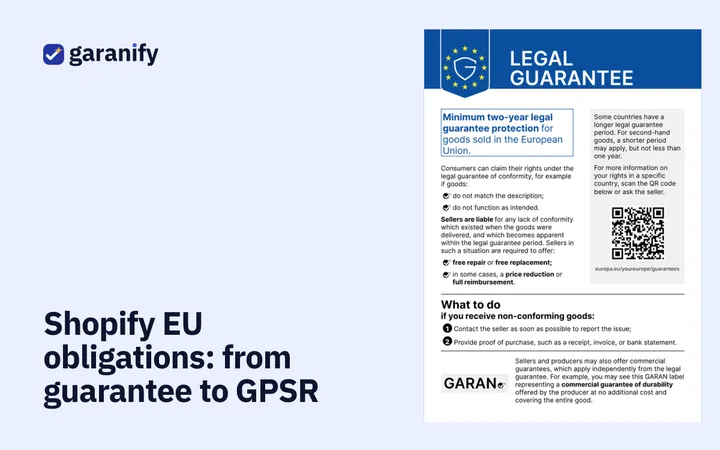
How Shopify itself covers the withdrawal function is explained in the article on EU obligations for Shopify shops.
What Garanify offers for this
A Garanify module for the withdrawal button is in preparation. Today Garanify shows the notice on the legal guarantee and the GARAN label under Implementing Regulation (EU) 2025/1960. Whether this obligation applies to your shop is shown by the obligation check.
Next steps
- Obligation check for the legal guarantee notice
- Black Friday checklist for online shops
- EU obligations for Shopify shops
- Help centre
Not legal advice. Garanify currently implements the display obligations of Implementing Regulation (EU) 2025/1960 technically; further modules are in preparation.