Who must provide the GPSR details?
As of 18 November 2026. Scope: EU-wide, since the GPSR is a regulation and applies directly. This text does not cover national rules on penalties.
The GPSR requirements affect every shop that offers products within the meaning of the General Product Safety Regulation (Regulation (EU) 2023/988) online. Under Art. 3 point 1, a product is any item intended for consumers or likely to be used by consumers. The definition looks at the product and does not mention the individual buyer. Art. 19 regulates what must appear in the offer on the product page and has applied since 13 December 2024 (Art. 52). Art. 19 contains no exemption for small businesses.
What does Art. 19 GPSR require?
Art. 19 is headed “Obligations of economic operators in the case of distance sales”. Where economic operators make products available on the market online or through other means of distance sales, the offer must indicate “at least” four items, each clearly and visibly:
| Point | Detail |
|---|---|
| (a) | Name, registered trade name or registered trade mark of the manufacturer, as well as the postal and electronic address at which they can be contacted |
| (b) | Where the manufacturer is not established in the Union: the name, postal and electronic address of the responsible person within the meaning of Art. 16(1) GPSR or Art. 4(1) of Regulation (EU) 2019/1020 |
| (c) | Information allowing the identification of the product, including a picture of it, its type and any other product identifier |
| (d) | Any warning or safety information to be affixed to the product or to the packaging or included in an accompanying document in accordance with the GPSR or the applicable Union harmonisation legislation, in a language which can be easily understood by consumers, as determined by the Member State |
The Regulation names no particular form. Under Art. 19 the offer must indicate the details clearly and visibly. Whether a link or a collapsible section is enough is open (see “Which questions are open?”).
Which fields does the product page need?
The overview maps the details from Art. 19 to the data fields a shop maintains for each product. The “Typical source” column is a recommendation by the editorial team. It shows where the detail usually exists already, because manufacturers must give it on the product, the packaging or an accompanying document under the GPSR.
| Data field in the shop | Art. 19 | Typical source |
|---|---|---|
| Manufacturer: name, trade name or brand | Point (a) | Product, packaging or accompanying document (Art. 9(6)), supplier data |
| Manufacturer: postal and email address | Point (a) | as above |
| Responsible person: name, postal address, email (only for a manufacturer outside the EU) | Point (b) | Product, packaging, parcel or accompanying document (Art. 16(3)) |
| Product picture | Point (c) | own product photos |
| Product type and identifiers, such as type, batch or serial number | Point (c) | Marking on the product (Art. 9(5)) |
| Warnings and safety information in the language of the destination country | Point (d) | Product, packaging, accompanying document |
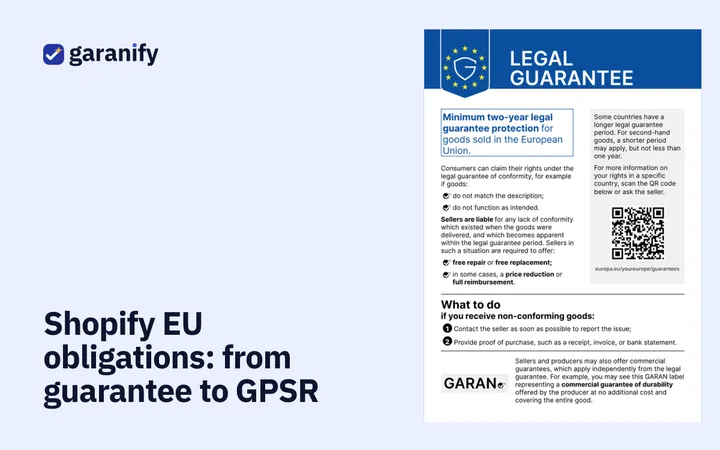
For Shopify, the overview of EU obligations for Shopify shows where GPSR details can be stored for each product.
Which products does Art. 19 cover?
Under Art. 2(1), the GPSR applies to products in so far as there are no specific provisions in Union law with the same objective regulating their safety. Where Union law lays down specific safety requirements for a product, the GPSR applies only to the aspects and risks that those requirements do not cover.
For products under Union harmonisation legislation (Art. 3 point 27, such as the rules for toys or electrical equipment), Art. 2(1) third subparagraph contains a rule of its own. These products are excluded from Chapter II in so far as the harmonisation legislation covers the risks. They are also excluded from Chapter III Section 1 and from Chapters V, VII and IX to XI. Art. 19 is in Chapter III Section 2. The distance sales obligations therefore apply to harmonised products as well.
Art. 2(2) excludes certain groups entirely, including medicinal products, food, feed and antiques. With effect from 13 December 2024 the GPSR repealed Directives 87/357/EEC and 2001/95/EC (Art. 50(1)).
Two terms come up often. “Making available on the market” is, under Art. 3 point 6, any supply of a product in the course of a commercial activity. “Placing on the market” is, under Art. 3 point 7, the first making available on the Union market. Art. 19 is tied to making available. It therefore also affects distributors that are not the first to sell a product in the Union.
What role does your shop have?
Art. 19 addresses “economic operators”. Under Art. 3 point 13 these are manufacturers, authorised representatives, importers, distributors, fulfilment service providers and other persons with obligations under the GPSR. Your role depends on the individual product and your position in the supply chain:
| Role | When | Provision | Consequence for the offer |
|---|---|---|---|
| Distributor | You sell products from other manufacturers and have not imported them yourself | Art. 3 point 11, Art. 12(1) | Details under Art. 19 in the offer. Before selling, make sure that the manufacturer and, where applicable, the importer have met their marking obligations (Art. 9(5) to (7), Art. 11(3) and (4)) |
| Manufacturer through own brand | You place a product on the market under your own name or brand | Art. 13(1) | Manufacturer’s obligations under Art. 9. Point (a) shows your name or brand |
| Importer | You are established in the EU and place a product from a third country on the Union market | Art. 3 point 10 | Obligations under Art. 11. You can be the responsible person (Art. 4(2) point (b) of Regulation 2019/1020) |
| Fulfilment service provider | For goods of others you provide at least two of these services: warehousing, packaging, addressing, dispatching | Art. 3 point 12 | Can be the responsible person if no other economic operator is established in the Union (Art. 4(2) point (d) of Regulation 2019/1020) |
What is the “responsible person”?
Art. 16(1) GPSR is tied to the product. A product covered by the Regulation may be placed on the market only if there is an economic operator established in the Union who takes on the tasks under Art. 4(3) of Regulation (EU) 2019/1020. That operator checks the conformity documentation, cooperates with the market surveillance authorities, provides information on a reasoned request and informs the authorities where a risk is suspected.
Who can take on this role follows from Art. 4(2) of Regulation (EU) 2019/1020:
- the manufacturer established in the Union,
- an importer, where the manufacturer is not established in the Union,
- an authorised representative appointed in writing by the manufacturer,
- for products it handles, a fulfilment service provider established in the Union, provided no other economic operator is established in the Union.
Art. 16 does not apply to harmonised products, because it is in Chapter III Section 1. Where a product falls under one of the acts listed in Art. 4(5) of Regulation (EU) 2019/1020, the corresponding obligation follows from Art. 4(1) of that Regulation. That is why Art. 19 point (b) names both provisions.
Under Art. 16(3) GPSR, the name, trade name or trade mark and contact details of this economic operator, including postal and email address, appear on the product, the packaging, the parcel or in an accompanying document. The details under Art. 19 point (b) belong in the online offer where the manufacturer is not established in the Union.
What does this mean for goods from third countries?
When a product is placed on the market in the EU, there must be an economic operator established in the Union for it (Art. 16(1)). If the manufacturer is outside the EU, the details of the responsible person under Art. 19 point (b) belong in the offer. This affects sellers from third countries particularly often. The Regulation names the possible roles and recommends no particular service providers. Which role fits your business model is something to clarify with legal advice or your market surveillance authority.
What are the risks of infringements?
Art. 44(1) obliges Member States to lay down penalties for infringements by economic operators and providers of online marketplaces. Under paragraph 2 they must be effective, proportionate and dissuasive. The Regulation names no amounts. The level follows from national law, which this text does not assess.
Which questions are open?
- Presentation. Art. 19 requires details that are indicated clearly and visibly in the offer. Whether a link or a collapsible section is enough is not regulated by the wording.
- Language of warnings. Art. 19 point (d) refers to the language determined by the Member State in which the product is made available. The rules of individual countries are in national law and are not assessed here.
- Product groups. Toys, electrical equipment, cosmetics and other groups have additional rules of their own. Art. 19 remains applicable alongside them.
- Pure B2B shops. Whether a shop that sells consumer products only to businesses falls under Art. 19 is not expressly answered by the wording.
- Marketplaces. For providers of online marketplaces the GPSR contains obligations of its own (Art. 22), which this text does not cover.
What should you do in your shop?
The following points are recommendations by the editorial team. What is mandatory is what Art. 19 and the provisions named above require.
- For each product, record the manufacturer with name, postal address and email, and note where the detail comes from.
- Mark products from manufacturers outside the EU and store the responsible person.
- Check whether every offer shows a picture and the product identifiers.
- Take over warnings and safety information in the language determined by the country you deliver to (Art. 19 point (d)). If you deliver to several countries, that can mean several languages.
- Show the details directly in the product presentation for as long as it is open whether a link is enough.
- Check newly added items again before promotions. For promotion week, the Black Friday checklist helps.
Further obligations meet on the same product page: the withdrawal function for contracts concluded online, and the indication of the lowest price of the last 30 days for price reductions.
What Garanify offers for this
A Garanify module for GPSR manufacturer details is in preparation. Today Garanify shows the notice on the legal guarantee and the GARAN label. With the obligation check you can see whether the legal guarantee notice applies to your shop.
Next steps
Not legal advice. Garanify currently implements the display obligations of Implementing Regulation (EU) 2025/1960 technically; further modules are in preparation.